
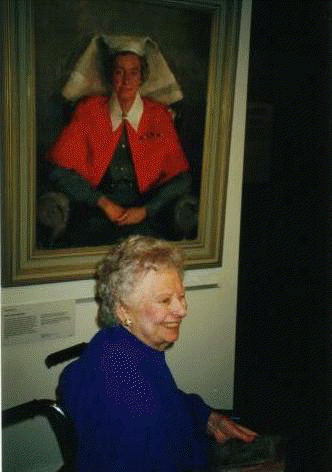
Vivian Bullwinkel
was the sole survivor
when the Japanese massacred 21 army nurses
on Bangka Island, now
part of Indonesia. She was taken POW and survived the hell camps of Sumatra

Thanks Joni Terrio
The Minefields Of Her Memory
Army nurse recalls duty in the
field hospitals of Europe
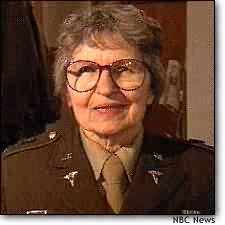
June Wandrey was one of
more than 70,000 women
who served as Army nurses
during World War II
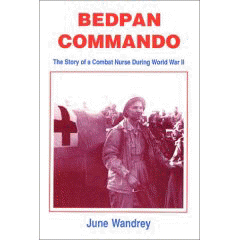
JUNE WANDREY PUT AWAY her memories
of
three years of
fighting in Europe when she came home in
1945.
But 40 years later, they resurfaced when she found a
box
of the letters she sent home from the war, all saved by
her mother.
"One thing that really bothered me about seeing
the
letters was that I had forgotten the vast majority of material
that was in it. I think you bury it... someplace down deep
inside," Wandrey says.
This time, she did not want to forget. She wanted
to
remember and others to learn. So she compiled her letters
and war diaries into a book. Its title: "Bedpan Commando,"
the nickname soldiers called the nurses who cared for them.
Looking at Wandrey now,
a small, wry woman, it's
hard to imagine how she endured the rigors of combat. The
living conditions were horrible. Her field hospital unit would
go months without heat or showers or a good night's sleep.
They lived on C-rations, sometimes heating their meals on
the radiator of an ambulance.
"We had
one condiment that was called alley slop," she
remembers. "And I always thought they would shake it on
their food and kill anything
in there that was live and
shouldn't have been."
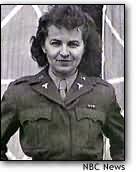
Jane Wandrey, pictured here
during her days as an Army nurse.
As she talks about her tour of duty through North
Africa, Italy, France and Germany, Wandrey
often rambles, switching subjects and
places as if to avoid the minefields of her own memory. But
there is one memory
she cannot avoid. The memory of a young man
she nursed
for three days in 1945. A young man she knew only as Sammy.
"Sammy was very badly wounded. He was just the
most cheerful, cheerful person in the world," she remembers
with tears in her eyes. "He had a voice
like an angel." She says his body was torn apart by a grenade — his
legs shattered, wounds in
his chest and stomach, and part of his brain exposed. Yet he still made
jokes and sang songs
as he fought to live. The scene she describes
is reminiscent of the novel and
movie, "The English Patient." As their
unit moves ahead, June and Sammy, a doctor and another nurse stay behind.
She learns Sammy was a singer before
he became a soldier, that he is married to a girl named Mary, and that
he wants to live.
He does not.She writes home: "Despite Sammy's
desperate battle to live, he slipped away just as morning broke. It broke
my
heart. Desperately tired, hungry and sick
of the misery and futility of war, I wept uncontrollably, my tears falling
on
poor Sammy's bandaged remains. Fifty-three years
have not dulled the pain. Crying, June
tells me that Sammy was every young man who fought
in World War II, and that in her opinion his life was wasted.
More than 70,000 women served as nurses in that
war and June believes every one knew a Sammy — someone
who came to personify the
horror of combat, the terrible price her generation was asked to pay to
save the next. A
price they paid without question For more
than 25 years this nurse has been haunted by a memory of Vietnam
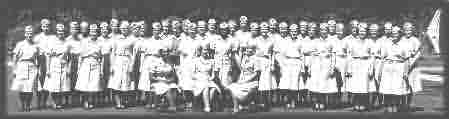
WAC Training Battalian, Fort. McClellan, Alabama
- 1961.
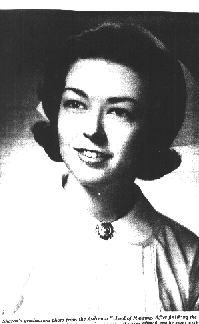
SHARON LANE
CHU LAI,VIETNAM 1969

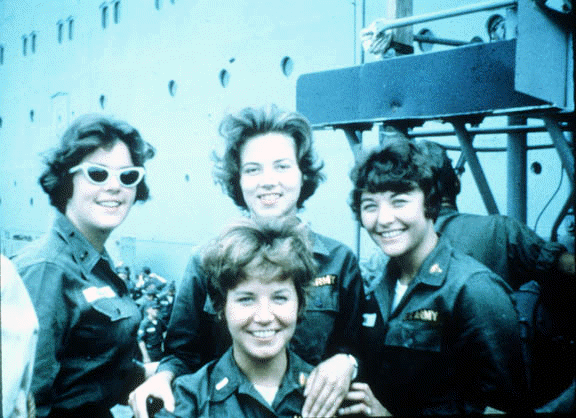
8th Field Hospital -Vietnam Nurses
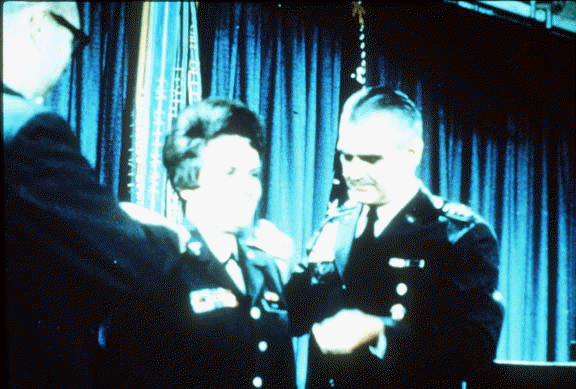
11 Jun 1970, Anna Mae Hays, the 13th Chief
of the Army Nurse corps, made history when she became the
first female ever promoted to the rank of
general officer in the U.S. Armed Forces.

OUR
GUARDIAN ANGELS

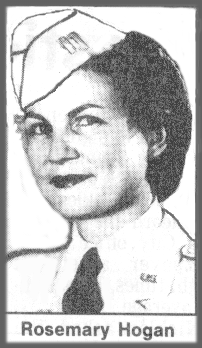
Rosemary Hogan, Captain
- Army Nurses Corps WW-II
Born May 12, 1912 at
Walters, Oklahoma. Entered service August 1, 1936 at Fort Sill Oklahoma
and served there until
1940. Captain Hogan served\ in the Asiatic Pacific Theater of War,
and participated in
the battles of Bataan and Corregidor. She was held POW by the Japs
from May 1942 to February
1945 and was wounded by shrapnel in the bombing
of Hospital # One at
Bataan, April 1942.Decorations: Asiatic-Pacific Medal, Pre-Pearl Harbor
Medal, Philippine
Liberation Medal, American
Defense Medal, Purple Heart, Bronze Star,Presidential Citation w/2 Oak
Leaf Clusters, 6 Overseas
Stripes.NOTE:Captain Rosemary Hogan is one of the nurses that volunteered
to
stay with the wounded
American soldiers. They knew that they would be overrun, captured and taken
prisoner by the Japs
and they were ordered to leave the wounded, and they did so.She was taken
prisoner, she survived
the awesome ordeal of being a POW for three years. She returned to the
states and was
promoted to Colonel.
Rosemary died in 1964 at the age of 52. I thank her for leaving me a free
country to live in.
If it were possible
to talk to the wounded men she volunteered to stay and care for, they would
say.
Thank God for the women
in the military.
These wounded men were
Hogan's Heros. She definitely was their Hero.
Rosemary Hogan and
the other American nurses were moved from Bataan to Corregidor just before
the surrender to the Japanese.
Some nurses and other
peronnel were evacuated from Corregidor before it was surrendered, including
Rosemary Hogan, who was, as
you mentioned, wounded
at Bataan. (She was wounded when a Japanese bomb fell on her hospital.
Nurse Rita Palmer was wounded
in the same bombing.)
The plane on which Hogan, Palmer, and other evacuees were flying had to
land on another island to refuel, and was
damaged. While the
pilots repaired the plane, the evacuees found shelter elsewhere. After
the plane was repaired, the pilots couldn't find
their passengers, and
had to leave them behind. The passengers eventually surrendered themselves
to the Japanese, as
they did not believe they could avoid capture.
Rosemary's
Story from Arlington
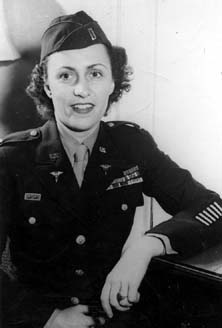
1st Lt. Rita
G. Palmer-POW 3 years
'It Was Terrible'
Former Army Nurse Reflects
On Horrors Of Being A War Prisoner
By Lara Bricker, Staff Writer
The Hampton Union, Tuesday,
May 30, 2000
[The following article is
courtesy of The Hampton Union and Seacoast Online.]
1st Lt. Rita G. Palmer
Only one small section of
my ward remained standing.
Part of the roof had been
blown into the jungle.
There were mangled bodies
under the ruins; a bloodstained hand stuck up through a pile of scrap;
arms and legs had been ripped
off and flung among the rubbish.
Some of the mangled torsos
were impossible to identify.
We worked wildly to get to
the men who might be buried, still alive, under the mass
of wreckage, tearing apart
the smashed beds to reach the wounded and the dead....
The bombing had stopped,
but the air was rent by the awful screams of the new-wounded
and the dying. Trees were
still crashing in the jungle and when one nearby fell on the
remaining segment of tin
roof it sounded like shellfire.... I saw Rosemary Hogan being helped
from her ward. Blood streamed
from her face and shoulder; she looked ghastly.
"Hogan," I called, "Hogan,
is it bad?"
She managed to wave her good
arm at me. "Just a little nose bleed,"
she said cheerfully ..."How
about you?"
... Then Rita Palmer (from
Hampton) was taken from her ward. Her face and arms had been
cut and her skirt and GI
shirt had been blown (open).
In fact, Rita Palmer had
more than a few cuts. "I remember coming to and having long beams of the
roof over
me and struggling out from
under those," she said. "I have no idea how long I was knocked out. I could
breathe
all right, but one finger
of one hand was incapacitated. I didn't even know about the piece (of shrapnel)
in my chest
for several hours. It didn't
penetrate my lung. I had shrapnel in my legs too."
{From "We Band of Angels:
The Untold Story of American
Nurses Trapped On Bataan by the Japanese"
Elizabeth M. Norman -- 1999}
--------------------------------------------------------------------------------
Rita Palmer doesn't like
to talk about her three years as a prisoner of war in Santa Tomas in Manila.
The memories don't come hack
easily. She prefers that they don't sometimes.
"I haven't talked about it
very much," the 82-year-old Hampton native said last week.
Palmer and Rosemary Hogan
were the first two women awarded a Purple Heart for their service in World
War II. T
hey were awarded the military
medal in San Francisco in 1945. Palmer keeps mostly silent about the honor.
"It didn't mean anything,"
she said. "They all did things so much more than we did."
Palmer never anticipated
the deadly turn of events when she enlisted as an Army nurse with the rank
of Second Lieutenant in March 1941.
Following her graduation
from the New England Deaconess Hospital in Boston, she saw the Army as
an opportunity to travel and see the world.
Opportunities for travel
were not as accessible to young people during that time as they are today,
her brother Ansell Palmer, 80, of Hampton, explained.
Rita Palmer wrote of her
feelings in a letter to her brother.
"After several months an
opportunity to transfer to the Philippines came along and being young and
eager to see the world, I volunteered," she wrote.
With five other nurses, she
left on September 26, 1941 and arrived in Manila on Oct. 23, where she
was stationed at Fort Stotensburg, 60 miles
north of Manila. Clark Field
was close by and Palmer wrote of her memories of the first day of war.
"The horror of that first
afternoon of war is burned in my memory - the dead, the dying, the dismembered
who filled every inch of our small hospital
are epitomized for me by
a legless 16-year-old who had lied about his age to get into the Army,"
she wrote. Clark Field was evacuated and the troops
and nurses were moved south
to Manila and by Christmas she was on Corregidor.
"Everything they bombed,"
Palmer said last week. "We were scared in a way. We didn't have time to
think about anything."
The nurses worked 18-hour
shifts and soon ran out of medical supplies. They rarely slept.
"It was almost constant,"
Palmer said.
From there, she worked on
the Bataan Peninsula where she was wounded, as described in the excerpt
from the book. Her brother explained
that she was then taken back
to Corregidor and was one of 12 army nurses who were to be taken at night
to Australia by Navy flying boats, PBYs.
The planes needed refueling
often and the flight stopped on Lake Lanao on the southern island of the
Philippines, Mindinao. However, the plane's
belly was ripped open by
a rock and they were grounded.
"Her PBY had had it and couldn't
make it from there," Ansell Palmer said.
For six months, the small
group stayed on the island but were eventually captured by the Japanese
and returned by a cargo boat to
Santa Tomas prison on Manila.
She was imprisoned for three and a half years.
"That was a long time," she
admitted.
At first getting food was
not that difficult, but soon they were eating only rice, cooked in milk.
"It was terrible," she said.
"Then it got so bad, our health was so bad."
Palmer and the others were
freed in 1945 after Gen. Douglas MacArthur's troops re-took Manila. She
remembers the day the Air Force
fighter planes flew over
the prison camp and tipped their wings. It was their first sign of liberation.
But some who had survived for the
entire length of time were
killed just before they were to be freed.
Meanwhile, Ansell Palmer
was stationed in Hawaii in the Navy Air Corps, where he was repairing planes.
What he knew of his sister was through
his mother and he learned
of her liberation when reading the base newspaper. He read that some of
the nurses were being brought to Hawaii and
after three hours of calling
different places on the phone, he was able to get through and talk with
his sister for the first time in four years.
Two hours later, he received
a phone call from the officer of the day who informed him that a high ranking
official had ordered Ansell Palmer to
be sent to his sister in
Honolulu "the fastest way possible."
It was February 23, 1945,
which is also Rita's birthday. He was shocked when he saw her at only 85
pounds. She returned to Hampton in August 1945
and later went on to the
University of Chicago, where she met her husband, Bud James, who also received
a
Purple Heart after he was
wounded in Italy.
Today, Palmer lives in Minneapolis,
Minn., and returned to Hampton last week to visit her brother. She hopes
when people think about the
nurses who served in World
War Il, they realize the significance of using women in combat, which wasn't
seen much before WWII.
Today, she said, women have
more opportunities for their careers and in leadership roles. She credits
the nurses with
opening up the future for
modern day women.
But she still is haunted
by the vivid memories of war.
"I have not successfully
come to terms with everything that happened in those years," she wrote
in a letter to her brother. "I learned some
valuable lessons, a great
deal about human nature under extreme conditions and the recognition that
little is gained and nothing is resolved by war."
Courtesy photo Hampton native
Rita Palmer was imprisoned in the Philippines for three and a half years
during World War 11.
She was one
of the first two women awarded a Purple Heart.

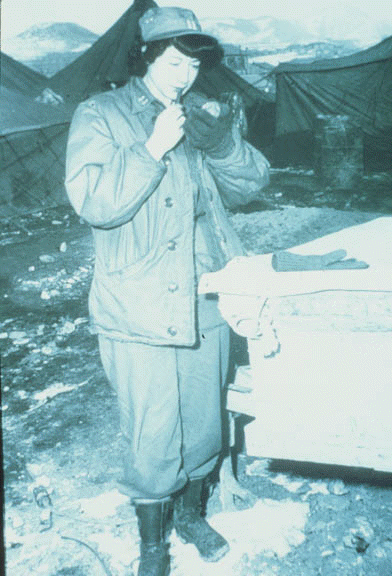
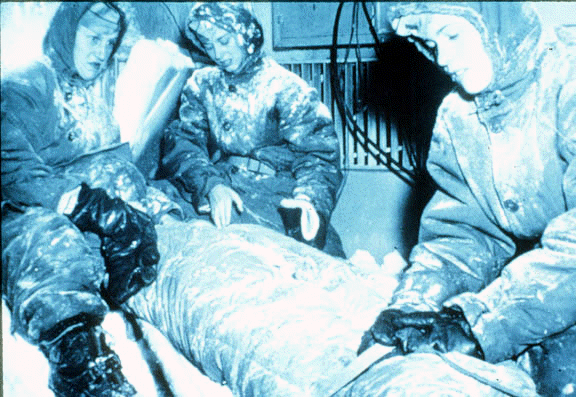
OUR KOREAN WAR NURSES



Mildred A. Radawiec
WWI Yeoman(F) Hardin




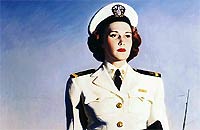
Eva Jane Bolents
WWII Nurse-Navy-Guam
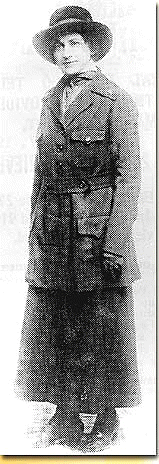
Mrs. Kate Battalion, war nurse during World
War I
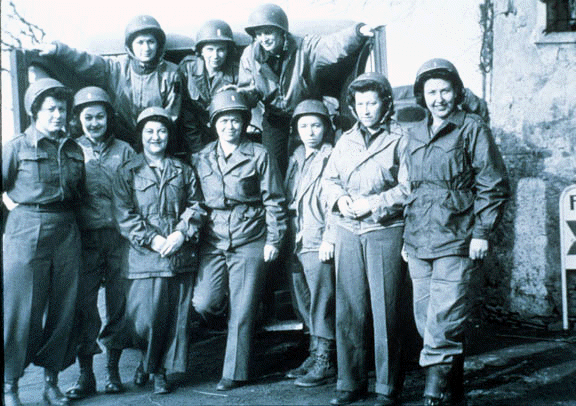
WWII Nurses


WOMEN IN THE MILITARY MEMORIAL
Vietnam Southeast Asia
1964-1975
Over 58,000 Americans killed, 200,000
wounded and Women Were There!
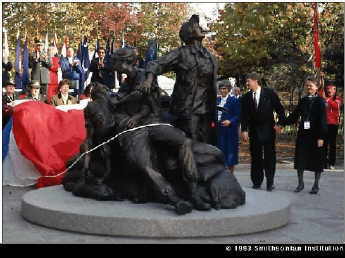
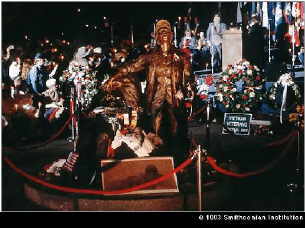
VIETNAM WOMANS MEMORIAL DEDICATION
NOVEMBER 11,1993
American Military Women
Who Died in the Viet Nam War (1959-1975)
Military:
U.S. Army
2nd Lt. Carol Ann Elizabeth Drazba
2nd Lt. Elizabeth Ann Jones
Lt. Drazba and Lt. Jones were assigned to the
3rd Field Hospital in Saigon. They died in a
helicopter crash near Saigon, February 18, 1966.
Drazba was from Dunmore, PA., Jones from
Allendale, SC. Both were 22 years old.
Capt. Eleanor Grace Alexander
1st Lt. Hedwig Diane Orlowski
Capt. Alexander of Westwood, NJ and Lt. Orlowski
of Detroit, MI died November 30, 1967.
Alexander, stationed at the 85th Evacuation Hospital
and Orlowski, stationed at the 67th
Evacuation Hospital, in Qui Nhon, had been sent
to a hospital in Pleiku to help out during a push.
With them when their plane crashed on the return
trip to Qui Nhon were two other nurses, Jerome
E. Olmstead of Clintonville, WI and Kenneth R.
Shoemaker, Jr. of Owensboro, KY. Alexander
was 27, Orlowski 23. Both were posthumously awarded
Bronze Stars.
2nd Lt. Pamela Dorothy Donovan
Lt. Donovan, from Allston, MA, died of pneumonia
in Qui Nhon on July 8, 1968. She was
assigned to the 85th Evacuation Hospital in Qui
Nhon. She was 26 years old.
1st Lt. Sharon Ann Lane
Lt. Lane died from shrapnel wounds when the 312th
Evacuation Hospital at Chu Lai was hit by
rockets on June 8, 1969. From Canton, OH, she
was a month short of her 26th birthday. She was
posthumously awarded the Vietnamese Gallantry
Cross with Palm and the Bronze Star for
Heroism. In 1970, the recovery room at Fitzsimmons
Army Hospital in Denver, where Lt. Lane
had been assigned before going to Vietnam, was
dedicated in her honor. In 1973, Aultman
Hospital in Canton, OH, where Lane had attended
nursing school, erected a bronze statue of
Lane. The names of 110 local servicemen killed
in Vietnam are on the base of the statue.
Lt. Col. Annie Ruth Graham, Chief Nurse at 91st
Evacuation Hospital, Tuy Hoa.
Lt. Col. Graham, from Efland, NC, suffered a
stroke in August 1969 and was evacuated to Japan
where she died four days later. A veteran of
both World War II and Korea, she was 52.
U.S. Air Force
Capt. Mary Therese Klinker
Capt. Klinker, a flight nurse assigned to Clark
Air Base in the Philippines, was on the C-5A
Galaxy which crashed on April 4 outside Saigon
while evacuating Vietnamese orphans. This is
known as the Operation Babylift crash. From Lafayette,
IN, she was 27. She was posthumously
awarded the Airman's Medal for Heroism and the
Meritorious Service Medal.
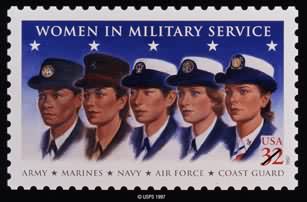
CHRIS NOEL
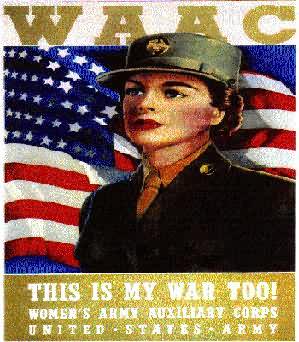


This is the Women's Army Corps Museum on the
grounds of Fort McClellan, Alabama.

This Col. Oveta Culp Hobby,
the first commandant of the Women's
Army Corps,
1942-1945. Col. Culp served as Deputy Secretary of the
Army for Women's
Affairs prior to her appointment as Commandant of
the Women's Army
Corps in 1942. Col. Hobby was always active in
Texas politics and
was the wife of the Publisher of the Houston Post,
later
assuming that position upon his death. In 1953, President
Eisenhower
appointed her to the position of Secretary of Federal
Security Agency, and later became the first Secretary Health, Education
and Welfare, a position she held until 1955, when she resigned to return
to
Houston to take care of her ailing husband.

DOC DENTICE SERVED WITH THE 25TH DIV. IN
CUCHI VIETNAM
DOC BROUGHT MANY WOUNDED TROOPS TO THE 12TH
EVAC
1967/68


DOCS WEB SITES
MUSIC
PLAYING ON MOST SITES
CLICK
ON THE LINKS BELOW
E-mail Doc










